Last orders: a short history of pub opening hours, from the 1915 wartime rules to the 2003 Licensing Act
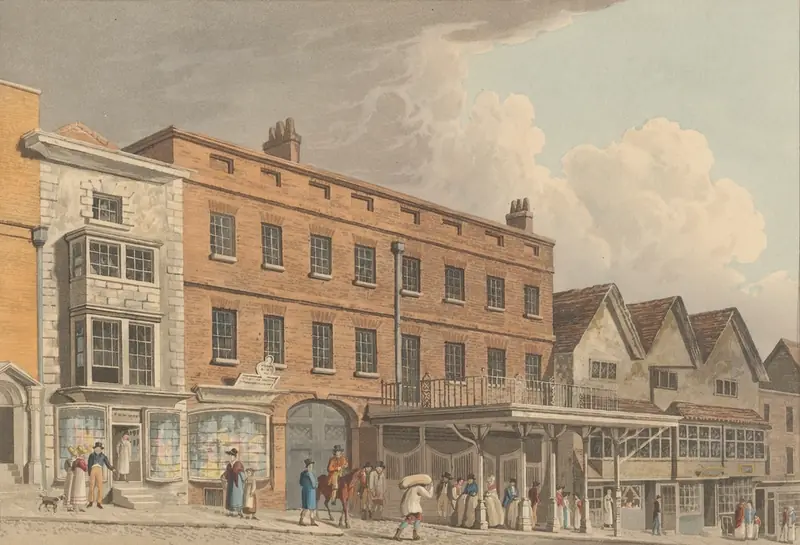
Illustrative print: an inn on a market square, in an early 19th-century print of Guildford's Old Corn Market and Tuns Inn. Credits
For most of the twentieth century, a British pub kept two sets of hours: a lunchtime session and an evening session, with the doors locked in between. The bell for last orders rang a few minutes before closing, the landlord called "Time, gentlemen, please!", and drinkers had a short period to finish their glasses. Many people still remember the afternoon closure. Few know that it began as an emergency measure in the First World War and lasted, in England and Wales, until 1988.
Before 1914: long days at the bar
Victorian licensing laws already regulated who could sell drink and where, and they set closing times, but by modern standards pubs could open for very long days. Wales was the great exception on Sundays: from 1881 its pubs were shut on the Sabbath altogether, a story told in our article on dry Sundays in Wales. The idea that a pub should close in the middle of the afternoon had not yet arrived.
1914 to 1918: drink and the war effort
The change came with the Defence of the Realm Act, passed in August 1914 at the start of the First World War. The government believed that heavy drinking was slowing down the production of munitions and the work of the docks and shipyards, and the Act gave it powers to restrict the sale of alcohol. David Lloyd George, then Chancellor of the Exchequer, is often quoted as saying in 1915 that Britain was fighting Germany, Austria and drink, and that drink was the greatest of the three.
Under the wartime rules, licensed premises were limited to a midday session and an evening session, with the exact hours varying from area to area. Beer was weakened, and in the area around the munitions works at Gretna and Carlisle the state went further and took over the breweries and pubs itself, a scheme that survived long after the war. Whatever their effect on drunkenness, the wartime hours created the shape of the British pub day for the next seventy years.
1921: the emergency becomes the rule
When the war ended, the restrictions did not. The Licensing Act 1921 made them permanent in a revised form. Pubs in urban areas could open from 11.30am to 3pm and from 6.30pm to 11pm; outside urban areas, the evening session ended at 10pm. On Sundays, opening was limited to a maximum of five hours, split between midday and evening. Pubs in Wales and Monmouthshire stayed closed on Sundays. Private members' clubs, by contrast, were allowed to set their own hours under their club rules, one reason why clubs became so important in Welsh social life.
A Royal Commission examined licensing between 1929 and 1931, but the hours survived it, the Second World War and the post-war years. Licensing law was reorganised several times, notably by the Licensing Act 1964, without changing the basic pattern of two sessions and an afternoon gap.
Calling time
The fixed hours gave the pub its rituals. Ten or fifteen minutes before closing, the landlord rang a bell or shouted "Last orders!"; at closing time came "Time, please!", traditionally "Time, gentlemen, please!". The law then allowed a short "drinking-up time" to finish what had been bought: ten minutes for most of the century, extended to twenty by the Licensing Act 1988. The scramble to buy a final round before the bell, and the crowds leaving every pub in a town at the same moment, were part of British life for generations.
Fixed hours shaped what pubs sold as well as when. Lunchtime trade, the after-work pint and the Sunday lunch all fitted into the permitted sessions, and a cellar had to be managed around them (see how cask ale is kept and served).
Scotland first, then 1988
Scotland moved first. The Licensing (Scotland) Act 1976, which took effect in 1977, gave local licensing boards the power to set opening hours. England and Wales followed more than a decade later with the Licensing Act 1988, which received royal assent on 19 May 1988. From 22 August 1988, pubs in England and Wales could open continuously from 11am to 11pm, Monday to Saturday, for the first time in almost 75 years. The weekday closing time became 11pm across the board, and the Sunday rules were loosened slightly.
The 1988 Act also allowed magistrates to impose a "restriction order" on a particular pub, removing some afternoon hours if the police, residents or a nearby school complained of disturbance. All-day opening was a freedom, not an obligation: many quiet country pubs kept closing in the afternoon simply because there were no customers.
Sunday caught up later. The Licensing (Sunday Hours) Act 1995 rewrote the Sunday rules, which had kept the long afternoon closure on the one day when many families went out for lunch. By then, of course, every part of Wales had voted to allow Sunday opening, the last district doing so in 1996.
2005: hours written into each licence
The Licensing Act 2003 swept the old system away. It received royal assent on 10 July 2003 and came fully into force on 24 November 2005. Instead of national permitted hours, each pub now has a premises licence issued by the local council, which states the hours during which it may sell alcohol. A pub can apply for any hours, up to 24 hours a day, and the council decides in the light of four licensing objectives: the prevention of crime and disorder, public safety, the prevention of public nuisance and the protection of children from harm. Residents and the police can object, and a licence can be reviewed if things go wrong.
The reform was controversial at the time, with fears of round-the-clock drinking, but a licence for longer hours does not oblige a pub to use them, and round-the-clock pubs remain rare. The Act also ended a small piece of pub decoration: the name of the licensee no longer has to be painted over the door, although many pubs still display it, and a summary of the premises licence must now be on display inside.
What is left of the old hours
- The words. "Last orders" and "time, gentlemen, please" are still heard, and many pubs still ring a bell before closing, even though the hour is now set by the licence rather than by Parliament.
- The habits. Eleven o'clock is still a familiar closing time in many pubs, a legacy of 1988 and of what pubs and their neighbours have grown used to.
- The variety. Since 2005 opening hours differ from one pub to the next. That is why this guide does not publish the Old White Hart's hours (what the inn was known for): check with the pub itself before you go.
Sources
- Alcohol licensing laws of the United Kingdom (the 1914 restrictions, the Licensing Act 1921 hours, the Royal Commission of 1929 to 1931, Scotland's 1976 Act, 22 August 1988, last orders, the 2003 Act and the licence summary)
- Licensing Act 1988 (royal assent, 11am to 11pm, drinking-up time from ten to twenty minutes, restriction orders, the 1995 Sunday hours Act)
- Licensing Act 2003 on legislation.gov.uk (premises licences and the four licensing objectives)